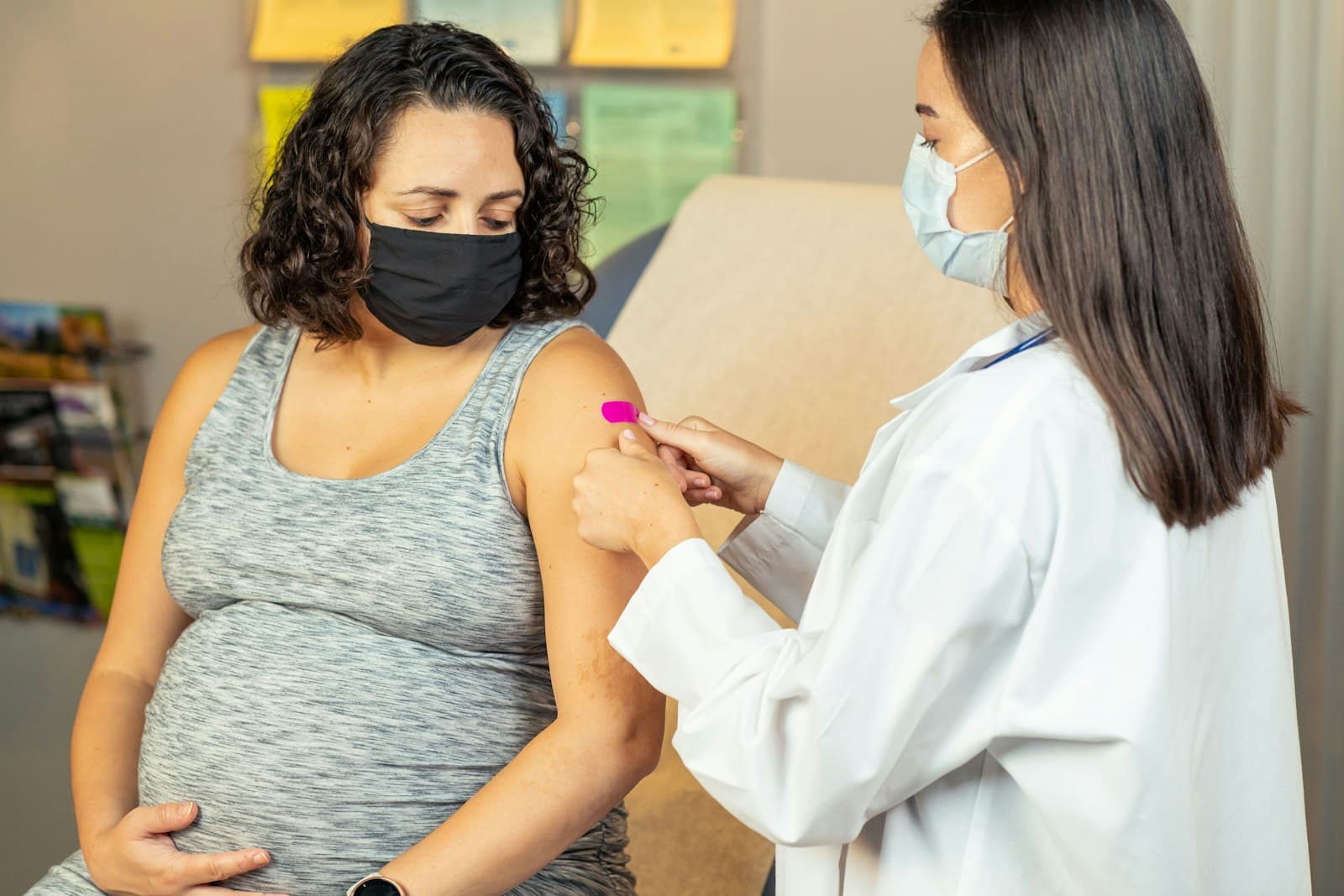
Which vaccines are recommended in pregnancy and are they free?
In its guide for pregnant women, the National Institute of Public Health PZH (Poland's public health institute) lists four recommended vaccines: flu, whooping cough (pertussis), RSV (respiratory syncytial virus) and COVID-19. All four appear in the section on vaccines recommended for pregnant women in the 2026 Immunisation Programme (Program Szczepień Ochronnych) published by the Chief Sanitary Inspector. The PZH states plainly that in Poland all vaccines recommended for pregnant women are free. They differ in whether you need a prescription and where you can get them.
| Vaccine | When in pregnancy | Cost and prescription | Where |
|---|---|---|---|
| Flu (injected vaccine) | in any trimester, ideally before the peak of the season | free, needs a prescription with entitlement code C | a POZ clinic (GP practice) or a pharmacy that vaccinates |
| Whooping cough (Tdap: Adacel or Boostrix) | from the end of week 27 to week 36, from the end of week 20 if preterm birth is a risk; in every pregnancy | free, no prescription or referral | the POZ clinic where you are registered |
| RSV (Abrysvo only) | 24-36 weeks according to the leaflet, ideally 32-36 weeks | free, needs a prescription with entitlement code C | a POZ clinic or a pharmacy that vaccinates |
| COVID-19 (mRNA vaccine) | in any trimester, the 2nd or 3rd trimester may protect the baby better | free, no prescription or e-referral | a POZ clinic or a pharmacy with an NFZ contract |
Vaccines dispensed in a pharmacy on a prescription with code C (the same code used for free medicines for pregnant women, the Ciąża+ programme) cost 0 zł. The 2026 Immunisation Programme says free vaccinations for pregnant women are given in POZ clinics, in pharmacies (except the whooping cough vaccine) and on hospital wards during a hospital stay. Before every vaccination you need a pre-vaccination assessment (kwalifikacja).
Flu vaccine in pregnancy: when and how do you get it?
According to the PZH guide, pregnant women get flu more often, and their risk of being hospitalised with it is higher than in women who are not pregnant and rises with each trimester. The vaccine also protects the baby: the PZH says babies of mothers vaccinated in pregnancy have a 70% lower risk of catching flu and an 80% lower risk of being hospitalised with it.
You can be vaccinated in any trimester. The PZH advises doing it before the busiest period, which in Poland usually falls in January to March, and names September to November as good months. In the 2026/2027 season, injected flu vaccines are free for pregnant women and women after birth (in the postnatal period), according to the PZH, under the Minister of Health notice of 17 June 2026.
- Ask for a prescription for the reimbursed vaccine with code C. Your pregnancy record card (karta przebiegu ciąży) or a certificate of pregnancy is the basis for it.
- Fill the prescription at a pharmacy. The vaccine costs 0 zł.
- Get vaccinated at a POZ clinic or at a pharmacy that vaccinates, after the pre-vaccination assessment.
The PZH guide describes vaccination at a POZ clinic and at a pharmacy as free. An older PZH answer from 2025, however, mentioned that a pharmacy may charge for the assessment and the injection according to its price list, so ask about this when you book.
Whooping cough vaccine in pregnancy: which week and why in every pregnancy?
Whooping cough is most dangerous for newborns and young babies. The PZH says the death rate is estimated at 1% among babies under 2 months, and a baby only starts their own whooping cough vaccines at 2 months and needs several doses. The antibodies a mother makes after vaccination in the third trimester cross the placenta and, according to the PZH, protect the baby for the first 3-6 months of life.
The Immunisation Programme and the PZH guide recommend one dose of the Tdap vaccine (against diphtheria, tetanus and whooping cough, with reduced amounts of some components) from the end of week 27 to week 36 of pregnancy. If the pregnancy is at risk of preterm birth, you can be vaccinated from the end of week 20, referred by the doctor who leads your pregnancy. The vaccine is repeated in every pregnancy, regardless of earlier doses.
The vaccine (Adacel or Boostrix or BoostrixPolio) is provided by the POZ clinic where you have registered (złożona deklaracja). You do not need a prescription or a referral, and it is free. This vaccine is not given in pharmacies. According to a large Australian study cited by the PZH, babies of mothers vaccinated in pregnancy had 61.5% fewer cases of whooping cough in their first 6 months.
Timing differs between countries. The British NHS offers the vaccine from 16 weeks, usually around 20 weeks, and advises having it before 32 weeks. If you live in Poland, follow the Polish recommendations and agree the date with the person leading your pregnancy.
RSV vaccine in pregnancy (Abrysvo): which week and is it reimbursed?
According to the PZH, RSV is one of the main causes of acute respiratory infections in young children, and in babies it can cause bronchiolitis and pneumonia. In Poland cases usually rise from November to March, peaking in December to February. In pregnancy the only vaccine you can have is Abrysvo. The PZH says (as of September 2026) that it is free for pregnant women on a prescription for the reimbursed vaccine.
The summary of product characteristics (SmPC) allows one dose between 24 and 36 weeks of pregnancy. Experts from the scientific societies cited by the PZH narrow this to 32-36 weeks, to get the greatest benefit and because the vaccine's safety is best understood in that period. The US CDC also recommends the 32-36 week window. The PZH advises vaccinating ideally 1-2 months before the RSV season starts, and no later than 2-3 months before it is expected to end. The season usually runs from October or November to April or May.
According to the PZH, in a clinical trial vaccinating the mother cut the risk of serious RSV complications in babies (low blood oxygen, mechanical ventilation, intensive care admission) by 82% in the first 3 months and by 69% in the first 6 months after birth. You can be vaccinated at a POZ clinic or at a pharmacy that vaccinates.
Advice on later pregnancies differs. The SmPC says the need to revaccinate in later pregnancies has not been established, and the CDC does not recommend it. The British NHS advises having the vaccine in every pregnancy. Ask the person leading your pregnancy.
Vaccinating the mother or an antibody for the baby (nirsevimab)?
A baby can be protected against RSV in two ways: by vaccinating the mother in pregnancy, or by giving the baby a ready-made monoclonal antibody after birth. The long-acting antibody is nirsevimab (brand name Beyfortus). According to the CDC, one of these two options is recommended and most babies do not need both. The PZH, for its part, notes that the mother's vaccination in pregnancy should not be a reason to exclude the baby from antibody prophylaxis if the baby qualifies for it.
In Poland free antibody prophylaxis does not cover all babies. According to the Institute of Mother and Child (Instytut Matki i Dziecka) in September 2026, reimbursement covers only selected risk groups, including premature babies, and no decision has been made to extend it to all newborns. If your baby may be in a risk group, ask the neonatologist before discharge from hospital, or the paediatrician, about RSV prophylaxis.
COVID-19 vaccine in pregnancy: is it still recommended?
Yes. The PZH says COVID-19 in pregnancy carries a higher risk of severe illness, intensive care admission and preterm birth. You can be vaccinated in any trimester, and in the 2nd or 3rd trimester the vaccine may also strengthen the baby's passive protection in the first 6 months of life.
Under the Minister of Health announcement of September 2026, COVID-19 vaccines are free in the 2026/2027 season, and pregnant women are among the groups for whom they are especially recommended. Vaccines are given at POZ clinics and at pharmacies with an NFZ (National Health Fund) contract, with no e-referral and no prescription. You book directly with the vaccination point. This season the mRNA vaccine Spikevax XFG is used.
Are vaccines in pregnancy safe and can they be given together?
None of the four recommended vaccines is a live vaccine. The PZH guide brings together data from large studies. A study of 9,000 women found no link between flu vaccination in the first trimester and birth defects, and studies have ruled out a link between this vaccine and miscarriage. In a British study of over 20,000 women vaccinated against whooping cough in the third trimester there were no more miscarriages or other adverse events. A 2024 meta-analysis covering 1.8 million women vaccinated against COVID-19 in pregnancy found no higher risk for the mother, the fetus or the baby.
For the RSV vaccine, the SmPC cites data from over 4,000 vaccinated pregnant women that do not point to birth defects or harm to the fetus or newborn. In the phase III trial, preterm birth occurred in 6% of women after the vaccine and in 5% after placebo. According to the PZH, the most common reactions after vaccination are pain at the injection site, headache and muscle pain.
The 2026 Immunisation Programme recommends giving the COVID-19 and flu vaccines at one visit. The RSV vaccine can be given together with the flu and COVID-19 vaccines. Between the RSV vaccine and the whooping cough (Tdap) vaccine, the Immunisation Programme and the SmPC recommend a gap of at least 2 weeks. The PZH guide also cites committees in the US and the UK that allow both vaccines on the same day. In practice, whooping cough from week 27 and RSV at 32-36 weeks gives this gap naturally. Decide on the order and dates with the person who assesses you for vaccination.
Which vaccines must you not have in pregnancy, and what about breastfeeding?
According to the PZH, pregnancy is a contraindication to live vaccines: MMR (measles, mumps and rubella) and chickenpox (varicella), because of the theoretical risk of the vaccine virus passing to the fetus. After a live vaccine you should not get pregnant for at least a month. The free flu vaccines for pregnant women are the injected ones. The nasal spray vaccine contains live, weakened viruses and is not used in pregnancy.
If you are planning a pregnancy, the PZH advises checking whether you have had rubella and chickenpox or been vaccinated, and getting vaccinated before pregnancy if needed. Women planning a pregnancy who have not been vaccinated against hepatitis B can get that vaccine free. According to the PZH, people living with a pregnant woman can have the MMR vaccine, and her older children can be vaccinated against chickenpox.
Breastfeeding is not a contraindication to vaccines recommended for adults. The PZH says that while breastfeeding you can have all inactivated vaccines, as well as live vaccines recommended for adults that were not given before pregnancy. In the 2026/2027 season the flu vaccine is also free in the postnatal period. For the RSV vaccine, the SmPC says it is not known whether it passes into breast milk, but no harmful effect has been shown in breastfed newborns of vaccinated mothers.
What can a midwife do about vaccines in pregnancy?
Poland's perinatal care standard requires information about vaccines recommended in pregnancy to be given at the very first visit, and antenatal education covers recommended and contraindicated vaccines and their safety in pregnancy and while breastfeeding. This education is given among others by the POZ midwife (położna POZ, the community midwife you register with).
- Assessment: according to the PZH, a pregnant woman can be assessed for vaccination by a doctor, nurse, midwife or pharmacist, among others. In a complicated pregnancy a gynaecologist's opinion may be needed.
- Prescription: in 2025 the Ministry of Health said it is best for a pregnant woman to get her vaccine prescription from an obstetrician-gynaecologist or a midwife, and that the pregnancy record card can be the basis for a prescription for free medicines.
- Vaccination plan: a midwife will help you time things so that whooping cough is done from week 27 and RSV at 32-36 weeks, and will remind you about flu and COVID-19 before the season.
- After birth: during home visits after the birth (wizyty patronażowe), the midwife reminds you about your baby's vaccinations and can answer questions about vaccines while breastfeeding.
In an online consultation with a midwife you can go through your pregnancy record card, work out which vaccines you are still missing and find the simplest place to get them. Whether a private midwife can write a code C prescription depends on how she works, so ask before the appointment. If you have a chronic condition or a complicated pregnancy, decide about vaccination with the person leading your pregnancy.