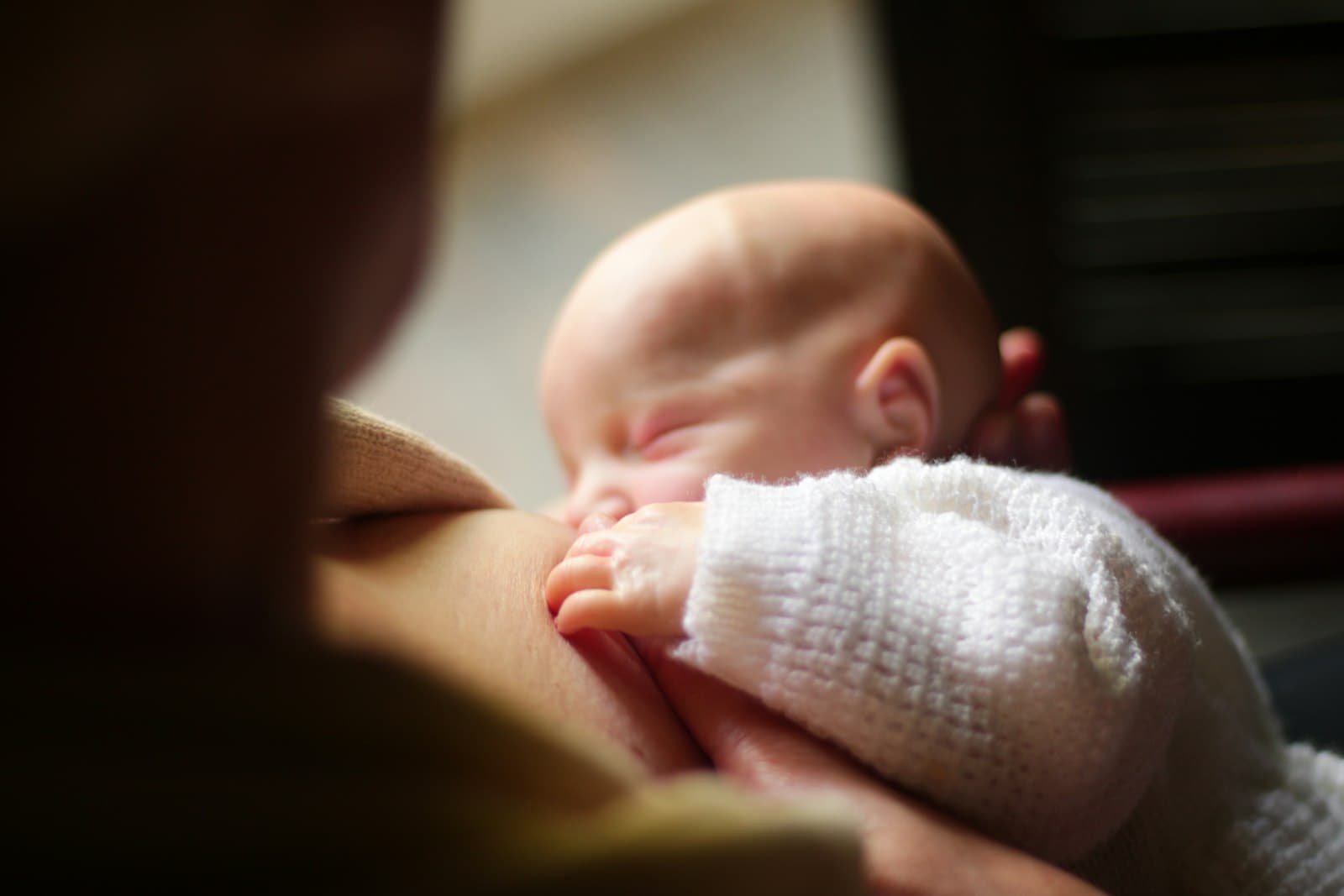
What is breast engorgement and when does it start?
In the first days after birth your breasts produce small amounts of colostrum. Roughly between days 3 and 5, milk production rises sharply and your breasts become bigger, heavier and warmer. According to the Academy of Breastfeeding Medicine (ABM), this can happen as late as days 9-10, though less often in women who have given birth before. After a caesarean section, milk often comes in later.
In everyday Polish, any such change is called nawał (engorgement), but the WHO distinguishes two conditions. Physiological fullness is normal: the breasts are full and milk flows well. Breast swelling (engorgement in the medical literature) is when the breasts are filled not only with milk but also with tissue fluid, so milk flows less easily and the baby finds it harder to latch.
| Full breasts (normal) | Breast swelling (engorgement that needs help) | |
|---|---|---|
| How they look | Warm, heavy and firm, without shiny skin or redness | Enlarged, tight, the skin may look shiny, sometimes with diffuse redness |
| Nipple and areola | Unchanged, the baby latches on easily | Swollen areola, flattened nipple, latching is difficult |
| Milk flow | Milk flows well, sometimes drips on its own | Milk flows with difficulty despite the fullness |
| How you feel | A feeling of fullness that eases after a feed | Pain in both breasts, sometimes a raised temperature that usually passes within 24 hours |
How long does breast engorgement last?
Physiological fullness passes quickly when the baby sucks effectively and empties the breasts often. The NHS explains that milk production needs a few days to adjust to a newborn's needs, which is why the worst discomfort usually lasts a few days. If a fever comes with the swelling, according to the WHO it usually goes down within 24 hours.
The feeling of fullness can also come back later, for example when your baby sleeps through a longer stretch of the night or you miss a feed. This is normal and usually passes after the next feed. If the pain and firmness do not ease and your baby cannot latch on, do not wait; ask a midwife for help.
How can I relieve breast engorgement?
Current guidance from the ABM (2022) and the NHS favours gentle methods that reduce swelling and help the baby feed, rather than mechanically "emptying" the breasts. In practice, this is what works:
- Feed often, on demand, as soon as your baby shows early signs of hunger, such as rooting for the breast or putting hands to the mouth. Crying is a late sign.
- Before latching, soften the areola with reverse pressure softening: place your fingertips around the nipple and press gently but steadily towards your chest for a few dozen seconds. The swelling moves back for a moment and it is easier for your baby to latch on.
- If the areola is still firm, hand express just a few drops or a little milk until it softens, then latch your baby on.
- After feeds and between feeds, apply a cold compress, for example a towel soaked in cold water or ice wrapped in cloth. The ABM says cold can be used as often as every hour.
- Use gentle lymphatic drainage: very light, stroking movements over the skin of the breast, without kneading the tissue.
- Wear a well-fitting, supportive nursing bra that does not squeeze your breasts.
- If you are in pain, you can take ibuprofen or paracetamol at the dose on the leaflet. According to the NHS, both are safe while breastfeeding.
Opinions on warmth are mixed. The NHS allows a brief warm compress just before feeding or expressing to help milk flow, but warns against strong, prolonged heat. The ABM points out that warmth widens blood vessels and may make the swelling worse. If warmth helps you, use it briefly and save the cold for after feeds.
Should I express milk when my breasts are engorged?
Express only as much as you need for relief or to soften the areola before a feed. Breasts make milk on a supply and demand basis, so the more you take, the more is made. The NHS and the ABM warn that expressing "until the breast is empty" drives oversupply and can make swelling and inflammation worse.
A breast pump makes sense when you are separated from your baby or your baby cannot suck, for example after a premature birth. In that case, express as often and as much as your baby would feed, and agree a plan with a midwife or lactation consultant.
Do cabbage leaves help with engorgement?
Cold cabbage leaves are a popular home remedy. A 2020 Cochrane review covering 21 studies and 2170 women suggests they may slightly reduce breast pain and firmness compared with usual care, but the certainty of this evidence is low or very low. The authors stress that no firm conclusions can be drawn about how well any of the methods studied work.
The ABM notes that cabbage leaves have not proved more effective than ice, so the relief most likely comes from the cold itself. It also adds that cabbage leaves may carry Listeria bacteria. If you like this method, wash and chill the leaves, but an ordinary cold compress will work in much the same way.
What should I avoid with breast engorgement?
- Firm, deep breast massage and trying to massage out hard areas. The ABM warns that this makes inflammation and swelling worse and can damage tissue.
- Massagers, vibrators and electric toothbrushes held against the breast.
- Pumping "until the breast is empty" after every feed.
- Prolonged, strong heat on the breasts.
- Skipping feeds and stopping breastfeeding suddenly. According to the NHS, this can make symptoms worse and lead to an abscess.
- Tight clothes and bras that squeeze your breasts.
- Oils, ointments and soaking the breasts in solutions, and for pain, aspirin, which the NHS does not recommend in this situation.
How can I tell engorgement from a blocked duct or mastitis?
The ABM describes these conditions as a single spectrum: from swelling during engorgement, through ductal narrowing (commonly called a blocked or plugged duct), to mastitis. Engorgement that is managed properly should not turn into a bacterial infection. The easiest way to tell them apart is whether the symptoms affect both breasts or one area, and whether you feel ill.
| Engorgement | Blocked duct | Mastitis | |
|---|---|---|---|
| When | Usually days 3-5 after birth | At any point while breastfeeding | At any point while breastfeeding, often after a blocked duct |
| Symptoms | Both breasts full, firm, swollen and painful | A tender lump in one breast, sometimes slightly red, no fever | A hot, painful, swollen area of one breast, often wedge-shaped, redness (less visible on darker skin), burning pain, fever, chills, feeling run down as with flu |
| What to do | Frequent feeds, softening the areola, cold after feeds, light lymphatic drainage | Feed as usual, no extra expressing from that breast, cold, painkillers, no squeezing or firm massage | Keep feeding, rest, cold, ibuprofen or paracetamol, have your latch checked by a midwife |
| When to see a doctor | When a fever does not pass after 24 hours or the pain and redness concentrate in one area of the breast | When the lump does not go away or you also get a fever and feel unwell | When there is no improvement after 12-24 hours of home treatment or you feel worse, and when there is still no improvement after 48 hours of antibiotics |
Milk from a breast with mastitis is safe for your baby, so you do not need to express it and pour it away. If a doctor prescribes an antibiotic, ask for one compatible with breastfeeding, as most can be taken without stopping breastfeeding.
When should I call a midwife and when should I see a doctor?
Contact a midwife straight away if your baby cannot latch on to a swollen breast, feeding is very painful, your nipples are damaged, or your breasts do not soften despite frequent feeding. The NHS advises asking a midwife or breastfeeding specialist to check your feeding as soon as possible in this situation, because improving the latch most often solves the problem and prevents it coming back.
See a doctor urgently, and if your condition is serious, go to the SOR (hospital emergency department) or call 112, if:
- you have a fever, chills and feel as if you have flu, and the symptoms do not ease after 12-24 hours or last longer than 24 hours
- part of one breast is red, hot and painful, and the redness is spreading
- a hard, very painful lump appears in the breast and does not go away, or pus comes out of the nipple
- at any point you feel clearly worse
- you have been taking an antibiotic for 48 hours and there is no improvement
You can get help with engorgement free of charge from a POZ midwife (a primary care midwife funded by the NFZ, Poland's public health insurer). After the birth she makes at least 4 wizyty patronażowe (postnatal home visits), the first within 48 hours (excluding weekends and public holidays) of being notified of the birth, and her tasks include lactation consultations and support with feeding problems. If you need help sooner or a longer visit, on MyMidwife you will find midwives with lactation experience who come to your home.