When should a newborn have their first bath?
In its 2022 recommendations, the WHO advises that the first bath of a healthy, full-term newborn should be delayed for at least 24 hours after birth. WHO experts found no evidence that an earlier bath is needed, for example when the baby is stained with meconium (their first poo). They stress instead that the newborn should not lose heat during the bath: a warm room, drying the baby straight away, clothing suited to the temperature, and keeping mother and baby together at all times.
In Poland, the perinatal care standard (the regulation setting out care in pregnancy, birth and after birth) provides that straight after birth the baby has at least two hours of uninterrupted skin-to-skin contact with the mother. On the maternity ward, all care procedures for a healthy newborn are carried out after informing the mother and with her consent, in her presence, as long as her health allows. So ask on the ward when the first bath is planned, and say if you want to be there or would rather it was postponed.
At home, give the first bath when you feel ready. Until then, washing the face, hands and bottom, described below, is enough. According to the NHS, it is better not to bath your baby straight after a feed or when they are hungry or tired.
How often should I bath my newborn?
Sources differ on the details, but they agree that a daily bath is not necessary for a newborn:
- The NHS says you do not need to bath your newborn every day and 2 or 3 times a week should be fine. If you and your baby enjoy a daily bath, you can bath them every day.
- The American Academy of Pediatrics (AAP) says that 3 baths a week during the first year may be enough, and that bathing more often can dry out a baby's skin.
- Medycyna Praktyczna, a Polish medical publisher, advises bathing an infant several times a week, ideally daily, but not more than once a day. In the first months a daily bath is not essential if you clean the nappy area thoroughly at every change.
On days without a bath, washing your baby's face, neck, hands and bottom is enough. Every day and at every nappy change, keep the bottom and genital area clean, because that is where the skin gets dirtiest.
What water temperature is right for bathing a newborn?
The water should be warm, not hot. The NHS advises checking it with your elbow: it should feel about the same as body temperature. Medycyna Praktyczna gives a slightly lower range of 33-34°C and describes it as a neutral temperature for an infant: if you dip your forearm or elbow in and feel neither cool nor distinctly warm, the water is right. A bath thermometer helps if you are unsure, but mix the water with your hand anyway.
- Run the cold water first, then add hot and mix it well so there are no hot patches.
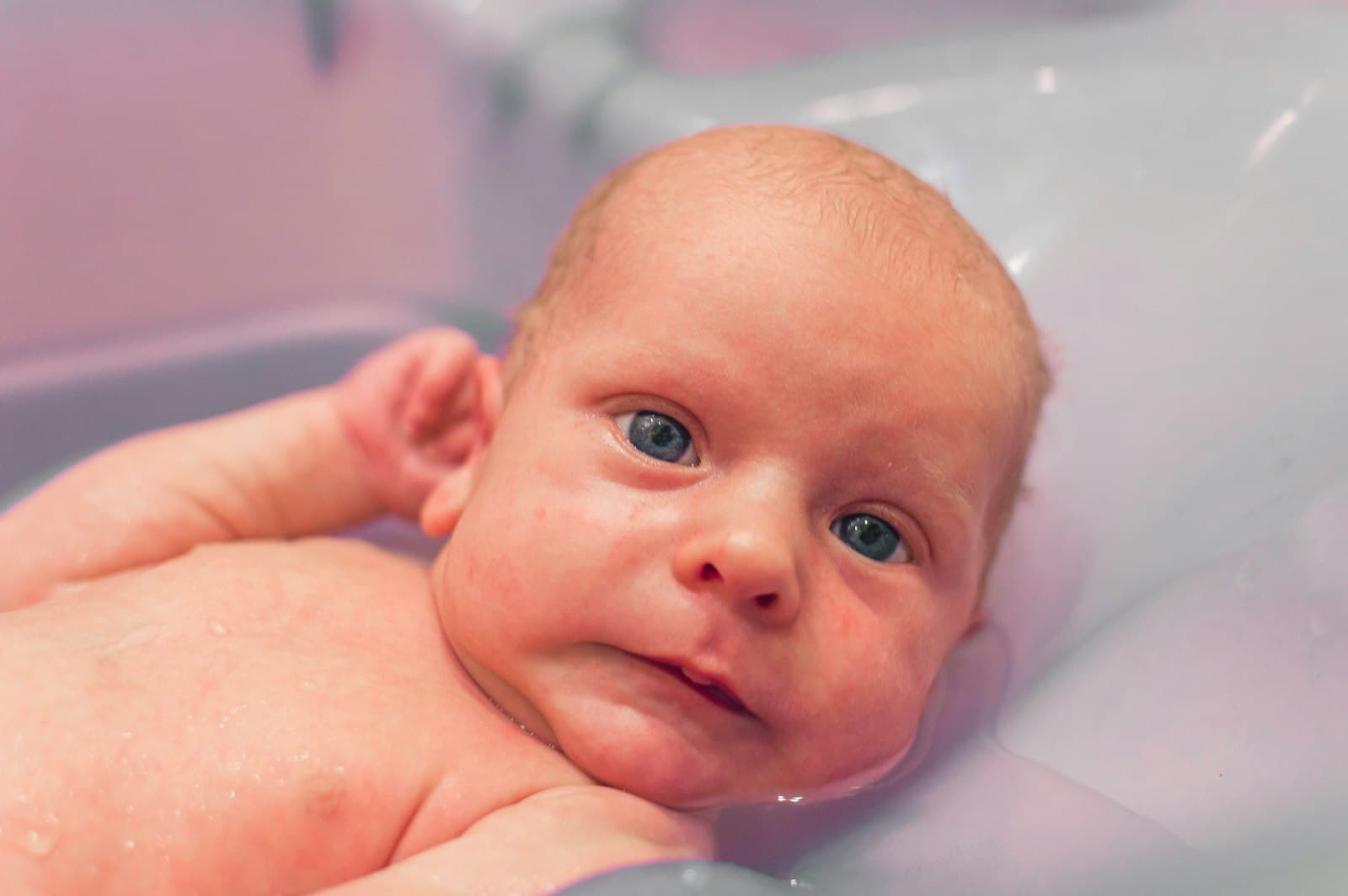
- Keep the water shallow. The NHS suggests 8-10 cm, and Medycyna Praktyczna advises that the water should cover the baby roughly up to the middle of their body.
- Warm the room before you start. A wet newborn loses heat very quickly, so keep the bath short and have the towel ready to hand.
- Do not bath your baby under running water from the tap. If you bath them in a sink, turn the tap off before you put your baby in the water.
What do I need to bath a newborn?
Get everything ready before you undress your baby, because during the bath you cannot step away from them even for a second. According to the NHS, you will need:
- a baby bath, a clean washing-up bowl or the sink,
- two towels,
- cotton wool to clean the eyes and face,
- a clean nappy,
- clean clothes.
Put the baby bath on a stable surface. Toiletries are not needed in the first weeks; more on that below.
How do I bath a newborn in a baby bath, step by step?
The order below combines NHS and AAP advice. At first, bathing with two people can be easier: one holds the baby, the other hands over the towel and clothes.
| Step | What to do |
|---|---|
| 1 | Check the water temperature with your elbow or a thermometer and make sure everything is within reach. |
| 2 | Undress your baby, leaving the nappy on, and wrap them in a towel. With your baby on your knee, clean their face: each eye with a separate piece of cotton wool dampened with warm water, wiping from the nose outwards. |
| 3 | Supporting your baby over the bath, wash their hair with plain water and dry it gently. |
| 4 | Take off the nappy and wipe away any poo before your baby goes into the water. |
| 5 | Lower your baby slowly into the water, feet first. Use one hand to support the head, neck and shoulders, for example by holding your baby's upper arm, and the other to guide the bottom and legs. |
| 6 | Keep the head above the water. With your free hand, pour warm water over the body and wash from top to bottom, leaving the bottom and genital area until last. |
| 7 | Lift your baby out, wrap them in a towel straight away and pat them dry rather than rubbing. Take particular care to dry the skin creases and the area around the belly button. |
| 8 | Put on a nappy with the top folded down below the belly button if the cord stump is still on, dress your baby and empty the bath. |
Clean the ears on the outside only. The NHS warns never to use cotton buds to clean inside your baby's ears.
How can I wash my newborn without a bath?
Between baths, and also when your baby does not like the bath, a wash without putting them in water is enough. In the UK this is called topping and tailing. The AAP recommends this kind of sponge bath until the cord stump falls off. According to the NHS and AAP, it goes like this:
- In a warm room, get ready two bowls of warm water, cotton wool, a towel, a clean nappy and clothes.
- Hold your baby on your knee or lay them on a changing mat. If the changing surface is raised, keep one hand on your baby at all times.
- Take off their clothes except the vest and nappy and wrap them in a towel. Uncover only the part of the body you are washing.
- Wipe each eye with a separate piece of cotton wool, from the nose outwards, then the face, neck, the outside of the ears and the hands.
- Take off the nappy and wash the bottom and genital area with water from the second bowl.
- Dry carefully, including in the skin creases, and put on a clean nappy.
Can I bath my newborn before the cord stump falls off?
Advice differs here. Polish neonatologists consider that getting the cord stump wet in the bath is not dangerous if you dry it thoroughly afterwards, while the AAP advises washing your baby only with a sponge or flannel until the stump falls off. Either way, the most important thing is that after the bath the stump is clean and dry and the top of the nappy is folded down below the belly button. You will find the details in our article on newborn umbilical cord care.
What toiletries should I use to bath a newborn?
In the first weeks, plain water is best. The NHS says liquid cleansers are not needed in the first month, and it is better to avoid lotions and oils until your baby is at least 1 month old. If you do want to use something, the sources advise:
- Choosing gentle, fragrance-free products made for babies. Products for adults, including scented bath products, can irritate a newborn's skin and weaken its natural protective barrier.
- Using soap sparingly, choosing a mild one with a neutral pH, and rinsing it off straight away.
- Not adding oily bath products until you are more practised, because they make your baby's skin very slippery.
- Not using shampoo on the head unless needed. According to Medycyna Praktyczna, washing the hair once or twice a week is enough.
- If the skin is smooth, not routinely applying anything after the bath. For dry skin, emollients, meaning products that moisturise and soften the skin, are used.
Peeling skin and cradle cap: what is normal?
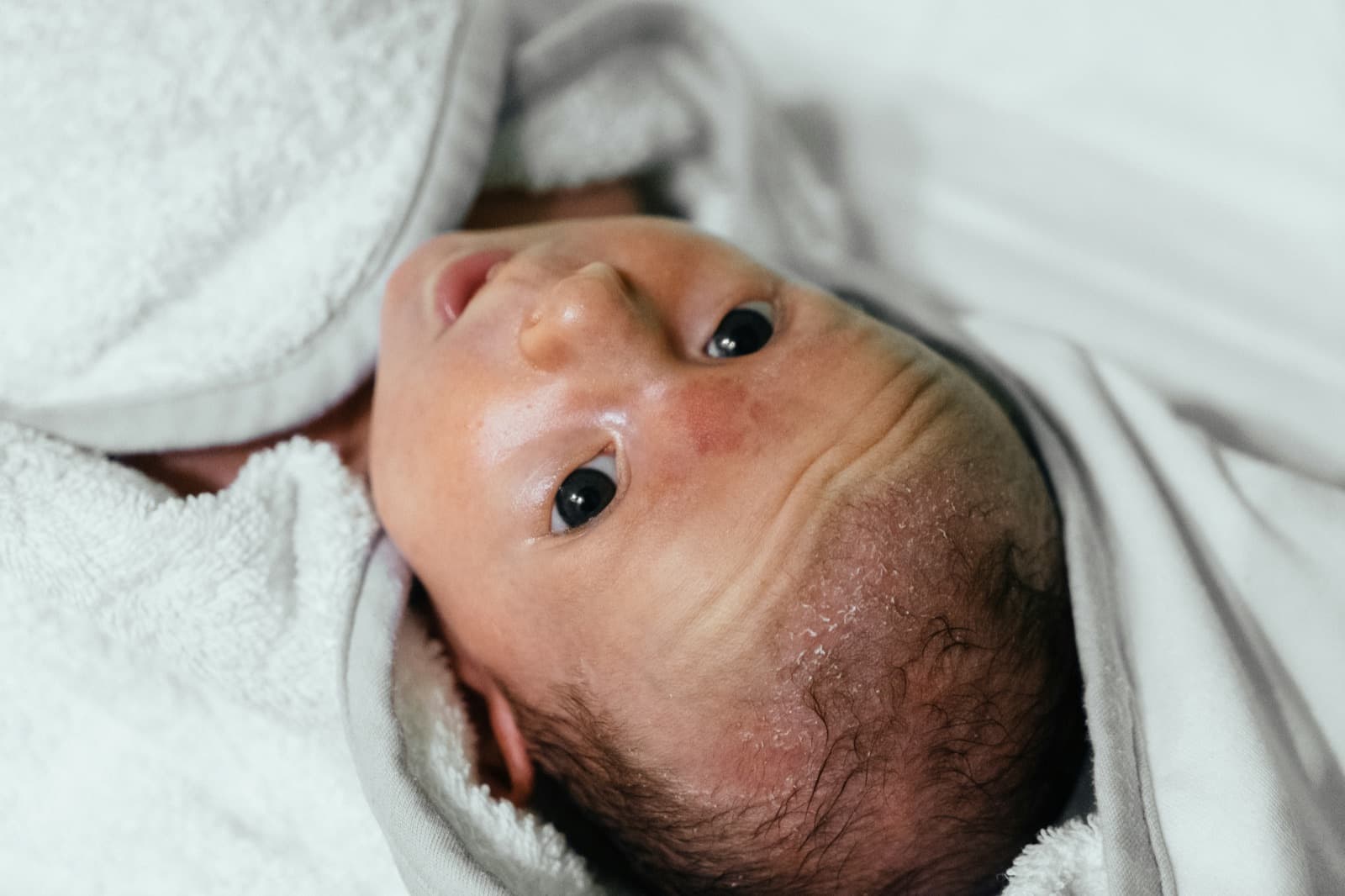
A newborn's skin often looks different in the first weeks from what you expect. According to the AAP, peeling skin is normal and usually needs no treatment. Tiny white or yellowish spots on the cheeks, chin and nose, called milia, usually disappear on their own within 2-3 weeks. A rash that appears in the first few days after birth, called erythema toxicum, is also very common.
Cradle cap is greasy, scaly patches on the scalp, sometimes also on the face. The NHS describes it as harmless, not itchy or painful, and says it usually goes away on its own within a few months. You can gently massage an emollient into the scalp to loosen the scales, brush them with a soft brush and wash the head. Do not pick at the crusts, as this increases the risk of infection, and do not use soap, adult shampoos or products with added fragrance.
How do I bath my newborn safely?
The two biggest dangers at bath time are drowning and scalding with hot water. The NHS and AAP give the same basic rules:
- Never leave your baby alone in the water, not even for a second. If the phone rings or someone knocks at the door, take your baby out, wrap them in a towel and take them with you.
- A baby can drown in a few centimetres of water, without making a sound. According to the AAP, most child drownings at home happen in the bath.
- Do not leave an older sibling to watch your baby in the bath. An adult must always be there.
- Do not use bath seats. The NHS and AAP advise against them, and the AAP points out that they can tip over.
- Always check the water temperature before you put your baby in. The AAP advises that hot water from the tap should be no hotter than about 49°C and suggests that you can often lower the temperature setting on your boiler or water heater.
- Empty the bath straight after use.
When should I ask a midwife about bathing and my baby's skin?
You do not have to give the first bath at home on your own. Under the perinatal care standard, the POZ midwife (a primary care midwife funded by the NFZ, Poland's public health insurer) gives instruction in newborn hygiene during the free postnatal home visits, called wizyty patronażowe, including how to bath your baby, skin care and care of the cord stump and belly button. She also assesses and records the state of your baby's skin, including redness, nappy rash, rashes and cradle cap, and how you look after your baby's hygiene. You can ask her to show you how to bath your own baby.
Show your baby to a midwife or doctor if you notice:
- a rash with blisters, because the AAP advises having every rash like this checked by a doctor,
- dry, cracked or red skin that does not get better despite gentle care,
- cradle cap that has not improved after a few weeks of care, covers the whole body, bleeds, oozes or looks swollen,
- redness of the skin around the belly button, pus or a bad smell from the cord stump.
If a rash comes with a fever, your baby is feeding poorly, is drowsy or is behaving differently from usual, do not wait for the visit; contact a doctor urgently. If you would like someone to show you how to bath your baby sooner or in addition, a private midwife can come to your home.