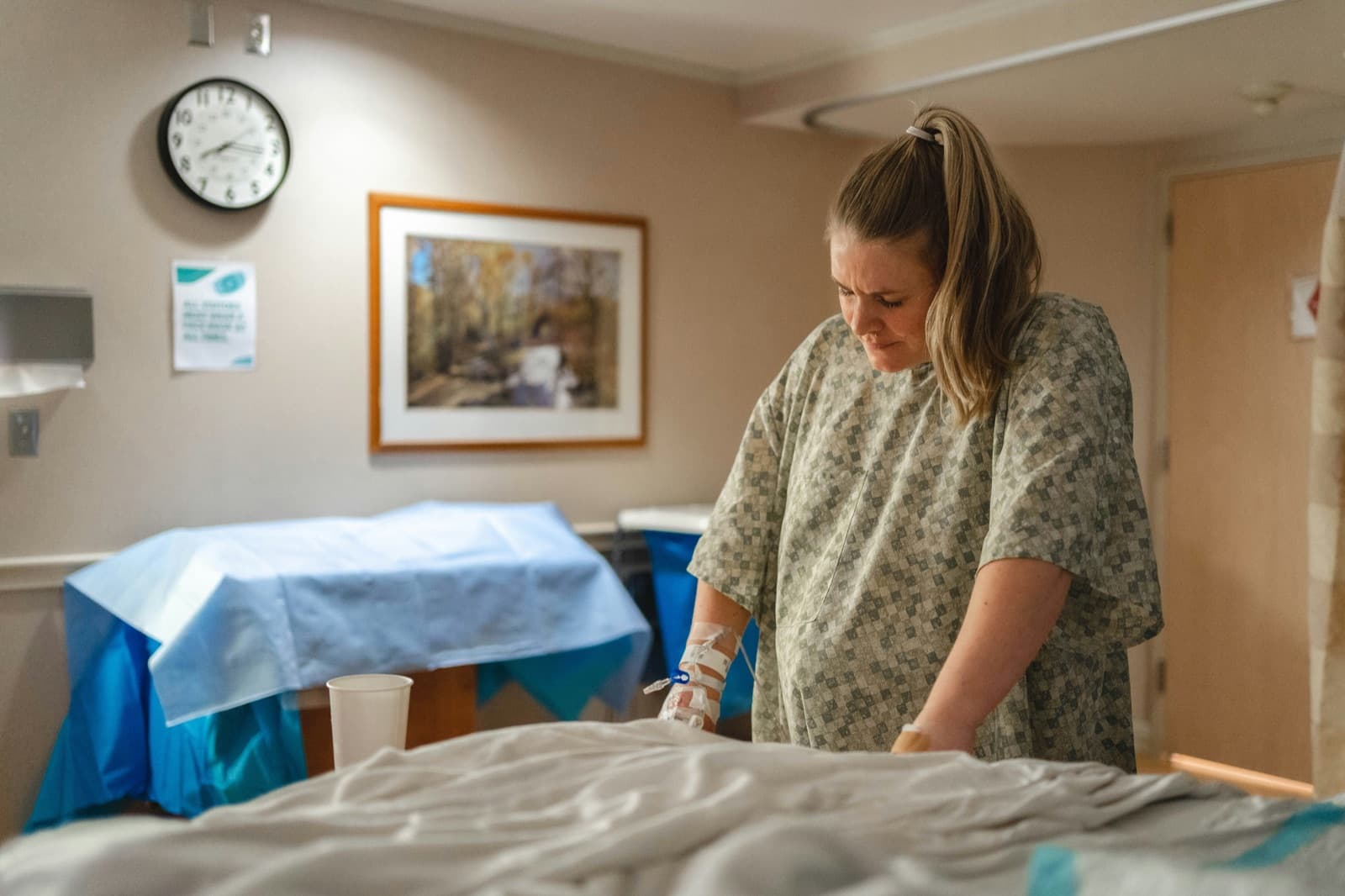
Is an epidural in labour free on the NFZ?
Yes. The Patient Rights Ombudsman points out that since July 2015 every woman can have an epidural during labour free of charge. The hospital bills the NFZ (National Health Fund) for it as a separate service, added on top of the birth. According to the Ministry of Health's answer to a parliamentary question from August 2025, from 1 July 2025 it was worth 1,176 zł. You do not pay for it.
Since July 2024 the NFZ has also rewarded hospitals where more vaginal births take place with an epidural, and lowered the rate for hospitals where there are very few:
| Share of vaginal births with an epidural at the hospital | Coefficient applied to the birth payment |
|---|---|
| below 5% | 0.95 (the hospital gets less) |
| above 10% | 1.12 |
| above 20% | 1.19 |
| above 35% | 1.21 |
Your right to pain relief comes from the organisational standard of perinatal care (consolidated text, Dz.U. 2026 poz. 1140). It says plainly that a woman in labour has the right to labour pain relief. The hospital, however, must provide at least one pharmacological method, not necessarily an epidural. It may be, for example, a gas you breathe in or intravenous medicines.
That is why access varies in practice. According to the NFZ, 17% of vaginal births in Poland had an epidural in 2023, and according to the Commissioner for Human Rights, in 2022 more than half of maternity units did not perform a single one. In a survey by the Patient Rights Ombudsman, 79% of facilities gave a shortage of anaesthetists as the reason. Under the standard, the anaesthetist running an epidural cannot look after other patients at the same time, except in emergencies involving other women in labour.
How can I check whether a hospital offers epidurals?
The standard places three duties on hospitals that help you check. The hospital publishes the pain relief methods it offers on its website and updates the list at least once a year. In pregnancy you have the right to see the place of birth and learn about the methods available in advance. When you are admitted in labour, staff must tell you in a way you understand which methods this hospital offers.
- The hospital website: look for the maternity ward pages and a document on labour pain relief. For example, the Rydygier Specialist Hospital in Krakow describes epidurals, gas (Entonox) and remifentanil in such a document.
- The Gdzie Rodzić hospital database of the Rodzić po Ludzku Foundation (gdzierodzic.info) has a filter for hospitals where an epidural is available during labour. We do not know how often the data is updated, so treat it as a starting point and confirm with the hospital.
- Call or visit the ward: ask whether an anaesthetist is available for women in labour around the clock, including nights and weekends, and whether there is an anaesthetic midwife or nurse.
- The anaesthetic consultation in pregnancy: the standard schedules it between 33 and 37 weeks for women who want an epidural. It is a good moment to ask about the rules at that hospital.
You can read more about choosing a hospital and when to go there in our article on the signs of labour.
When can you have an epidural? How many centimetres dilated?
The Polish standard does not give a number of centimetres. It says regional analgesia is started in the first or second stage of labour according to the woman's preferences, and continued into the second and third stages if you wish. Hospitals do have their own procedures, though. For example, the Rydygier hospital in Krakow writes that an epidural can be started in the active phase of the first stage of labour. Ask about this at your hospital.
Under the standard, pharmacological pain relief is used when non-drug methods do not bring the expected relief or when there are medical reasons. The next steps look like this:
- The obstetrician examines you, assesses how labour is progressing and how strong the pain is, and then orders the epidural.
- The anaesthetist sees you without delay, no later than 30 minutes after receiving the order.
- The anaesthetist assesses you and checks for contraindications. They explain how the epidural is done, how it affects labour and the baby, and what complications it may have.
- You sign a written consent form. Without it the epidural is not given.
How is an epidural put in?
According to the NHS, you first get a cannula and a drip. You sit leaning forward or lie on your side with your knees drawn up. The anaesthetist numbs the skin on your back, in the lumbar part of the spine, and passes a thin tube (catheter) through a needle close to the nerves that carry pain from the womb. The needle is removed, and medicines are given through the catheter, usually a local anaesthetic mixed with an opioid, and later further doses from a pump.
While the anaesthetist is inserting the needle, try to keep still and tell them when a contraction starts. Timings differ between sources. The NHS gives about 10 minutes to set it up and 10-15 minutes for it to work, while the information card of the UK Obstetric Anaesthetists' Association (OAA) gives about 20 minutes for each of these steps.
The standard also describes how you are monitored. For at least 30 minutes after the medicines are given you are under the direct supervision of the anaesthetist, and your blood pressure, pulse, breathing, oxygen saturation and the baby's heart rate are measured at least every 5 minutes. After that you are cared for by an anaesthetic midwife or nurse, who may look after only one woman in labour at a time. The anaesthetist reviews you at least every 90 minutes.
Does an epidural make labour longer and pushing harder?
Sources agree that an epidural relieves pain better than opioid medicines and does not raise the risk of a caesarean. They differ on the length of labour and on assisted birth:
- UK NICE guideline (NG235): an epidural does not make the first stage of labour longer or raise the chance of an unplanned caesarean, but it is linked to a longer second stage (pushing) and a higher chance of birth with forceps or ventouse.
- Cochrane review from 2018 (40 trials, more than 11,000 women): compared with opioids, an epidural was linked to longer first and second stages and more frequent use of oxytocin. Assisted births were more common, but the difference was no longer seen in trials carried out after 2005. The authors think modern low-dose techniques do not affect this outcome.
What about pushing? The NHS says you may not feel your contractions, so the midwife will tell you when to push. Towards the end of labour the dose can be reduced so that pushing feels more natural. NICE advises that after full dilation, if you have no urge to push and the baby's head is not visible, pushing can wait up to 1 hour if you have given birth before and up to 2 hours in a first birth. During this time the baby moves down the birth canal by itself.
With an epidural you do not have to lie on your back. NICE recommends any comfortable position, including upright, except lying flat on your back. If the midwife checks that you have enough strength and feeling in your legs, you can walk with help, although your legs may feel heavier than usual.
What are the side effects of an epidural?
According to the NHS and the Cochrane review, more common, usually temporary effects are a drop in blood pressure, heavy or weak legs, itchy skin, fever and difficulty passing urine, for which a catheter is sometimes used. The insertion site may be tender for a few days. According to NICE and Cochrane, an epidural does not cause long-term backache, and Cochrane found no differences in Apgar scores or in newborn admissions to intensive care.
The OAA information card (March 2021 edition) gives estimated rates of complications. It stresses that these are approximations and may differ between hospitals:
| Complication | How often |
|---|---|
| Significant drop in blood pressure | 1 in 50 women |
| Not relieving pain well enough, so another method is needed | 1 in 8 women |
| Severe headache | 1 in 100 women |
| Temporary nerve damage (numb patch or weak leg) | 1 in 1,000 women |
| Nerve damage lasting more than 6 months | 1 in 13,000 women |
| Epidural abscess (infection) | 1 in 50,000 women |
| Meningitis | 1 in 100,000 women |
| Epidural haematoma (blood clot) | 1 in 170,000 women |
| Severe injury, including paralysis | 1 in 250,000 women |
Sources differ on headache. The NHS and the OAA give about 1 in 100 women, while a 2017 article on mp.pl mentions about 10% of women who had the procedure. Ask the anaesthetist what figures your hospital has.
Who cannot have an epidural?
Whether an epidural is safe for you is decided by the anaesthetist together with the obstetrician. Before an epidural the standard requires a physical examination, an assessment on the ASA scale, a check of the eligibility criteria, diagnostic tests and an obstetric examination. Mp.pl lists these contraindications:
- you do not consent,
- blood clotting disorders, including a low platelet count,
- reduced circulating blood volume or shock,
- infection at the planned insertion site,
- sepsis.
If you take blood thinners or have a blood or spine condition, mention it at the anaesthetic consultation in pregnancy. When an epidural cannot be given, intravenous remifentanil may be an alternative, according to mp.pl and the Rydygier hospital.
What other methods of labour pain relief are there?
The standard lists non-drug methods in particular as: movement and positions that ease pain (walking, rocking, squatting, a birth ball, a bean bag, wall bars, a mattress, birth ropes, a birthing chair), breathing and relaxation techniques, massage, warm or cold compresses, TENS (transcutaneous electrical nerve stimulation), water immersion, acupuncture and acupressure. They are used by the midwife or your birth partner. Pharmacological methods are inhaled analgesia, intravenous opioids, and regional and local anaesthesia.
| Method | How it works | What the sources say |
|---|---|---|
| Breathing, massage, a shower or bath | Help you relax, especially early in labour | NICE: may reduce pain in the latent first stage of labour |
| Water immersion | Labour, or part of it, in a bath or birth pool | NHS and NICE: water no warmer than 37.5 degrees C, and the temperature is checked |
| TENS | Pads on your back, you control the strength yourself | NHS: may help in early labour, especially with lower back pain. NICE: very little evidence it works in established labour, but no evidence of harm |
| Gas and air (Entonox) | A 50:50 mix of nitrous oxide and oxygen, breathed through a mouthpiece or mask | NHS: works in 15-20 seconds and reduces pain but does not remove it. It can cause nausea, light-headedness and sleepiness. Used for more than 24 hours it can lower vitamin B12 levels |
| Intravenous remifentanil | An opioid from a pump, you give yourself a dose by pressing a button | NICE: only in hospital, with a midwife present at all times and breathing monitored. It can cause sleepiness, nausea and a need for oxygen |
| Pethidine or diamorphine (injection) | An opioid given into a muscle | NHS: starts working in about 20 minutes and lasts 2-4 hours. It is not given just before birth because it can affect the baby's breathing and make the first feed harder |
The Polish standard requires that intravenous opioids are given with a pump from which you can give yourself a dose, with continuous CTG and breathing checks. There is also a pudendal nerve block, which the obstetrician gives without an anaesthetist. You can combine methods and change them during labour.
How do I ask for an epidural and put it in my birth plan?
Under the standard, a birth plan covers your expectations about pain relief methods. Staff must read it, discuss the available pain relief methods with you and follow it where possible. We explain how to write the whole plan in our article on birth plans.
- At 27-32 weeks: the standard schedules antenatal education that covers labour pain relief. Ask your primary care (POZ) midwife or antenatal class about it.
- At 33-37 weeks: book the anaesthetic consultation. If that did not happen, the standard also schedules it at 38-39 weeks and after 40 weeks.
- In your birth plan, write for example: "I want to try water immersion and massage first. If that is not enough, I would like an epidural" or "I would like an epidural as soon as possible".
- When you are admitted in labour, say straight away that you are thinking about an epidural and ask whether an anaesthetist is available now.
- During labour you can change your mind either way, including asking for an epidural that was not in your plan.
What does the midwife do about labour pain relief?
An epidural is always put in by an anaesthetist and only in hospital, so it is not available at a home birth. The midwife's role is still a big one. Under the standard, the midwife leading the birth uses non-drug methods with you and chooses them together with you. With an epidural you are cared for by an anaesthetic midwife or nurse, who measures your observations, checks how well the epidural is working and gives further doses as prescribed by the doctor.
During pregnancy, your POZ midwife can talk through pain relief methods with you as part of free antenatal education and help with your birth plan (more in our article on antenatal classes on the NFZ). A midwife you choose privately for the birth can stay with you, help with changing positions, massage and breathing, and remind staff about your plan. She cannot replace the anaesthetist, but she can help you through labour until the epidural works, or without one.
When should I get help after an epidural?
Complications are rare and are usually picked up while you are still in hospital. The OAA leaflet on recovery from an epidural lists the symptoms that need checking. In hospital, tell your midwife. At home, call the hospital where you gave birth or go to the emergency department (SOR). If you have sudden weakness in your legs, lose control of your bladder or bowels, or have a headache with a stiff neck and fever, call 112.
- A headache that gets worse when you sit or stand and eases when you lie down.
- A headache that does not go away after rest, fluids and paracetamol, or makes it hard to look after your baby.
- A headache with a stiff neck, hearing changes (ringing or a blocked feeling) or sensitivity to light.
- Severe or worsening back pain at the injection site, or pain travelling up the spine or down into the buttocks and legs.
- Redness, warmth or oozing at the injection site, a fever and feeling unwell.
- Loss of control of your bladder or bowels.
- Difficulty walking, weak legs, numbness or pins and needles in your legs or buttocks.