Can you breastfeed with a cold, flu or COVID-19?
In most cases, yes. The CDC, the US public health agency, says that even when a mother has flu, breast milk remains the recommended food for her baby. It contains antibodies and other immune factors that can help protect the baby against flu.
The same goes for COVID-19. According to the CDC, breastfeeding mothers with suspected or confirmed COVID-19 should keep breastfeeding while following hygiene precautions, and SARS-CoV-2 is not passed to the baby through breast milk. Milk from mothers with COVID-19 contains antibodies that may give the baby some protection.
A runny nose, sore throat or cough is no reason to stop breastfeeding. If you feel too ill to feed, the CDC advises expressing milk regularly to keep up your supply and asking a healthy person to give it to your baby. They can use a cup, a syringe or a bottle.
How do you protect your baby from catching it while you breastfeed?
When you breastfeed while ill, hygiene is what helps most. For flu and COVID-19 the CDC recommends:
- Wash your hands with soap and water before touching your baby, before touching things your baby will touch, and after sneezing or coughing into your hands. For COVID-19 the CDC accepts hand sanitiser with at least 60% alcohol when soap and water are not available.
- Consider wearing a face mask during close contact, for example while feeding. Children under 2 should not wear masks.
- Wash your hands before expressing milk and clean pump parts and bottles thoroughly after each use.
- Air your home to improve ventilation.
- Cover your mouth and nose when you cough or sneeze and throw used tissues away straight away, as the NHS advises. According to the NHS, with flu you are most infectious during the first 5 days.
Which cold and flu medicines can you take while breastfeeding?
The NHS points out that most medicines pass into breast milk in very small amounts and very few are unsafe while breastfeeding. Always tell your doctor and pharmacist that you are breastfeeding, and if your baby was born prematurely or had jaundice, mention that too, because it can affect which medicine you can take. The table sums up what our sources say about common substances. It does not replace advice from a doctor or pharmacist, and always check the dose on the leaflet.
| Substance | Typical use | OK while breastfeeding? | Notes and source |
|---|---|---|---|
| Paracetamol | Fever, headache, muscle aches, sore throat | Yes, first choice | NHS: usually the best painkiller while breastfeeding. Do not combine it with “cold and flu” sachets or tablets that also contain paracetamol. |
| Ibuprofen | Fever, pain, inflammation | Yes, usually | mp.pl: a first choice alongside paracetamol. NHS: check with a pharmacist or doctor before using it. |
| Acetylsalicylic acid (aspirin) | Pain, fever, an ingredient in some “cold” powders | Best avoided | NHS: not recommended as a painkiller while breastfeeding. mp.pl: use with caution. |
| Pseudoephedrine (tablets, powders for a blocked nose and sinuses) | Blocked nose | Best avoided | LactMed: even a single dose can reduce milk production. The NHS advises against decongestants taken by mouth. |
| Phenylephrine taken by mouth | Blocked nose, an ingredient in “flu” powders | Better to choose something else | The NHS advises against decongestants taken by mouth. Sources differ on its effect on milk supply (see below). |
| Xylometazoline, oxymetazoline (nasal drops or spray) | Blocked nose | Usually yes, short term | LactMed: very little reaches the baby, a better choice than tablets. Breastfeeding Network: no more than 5 days in a row. NHS: ask a pharmacist. |
| Throat lozenges | Sore throat | Yes | mp.pl: locally acting products such as nasal drops and throat lozenges are safe. |
| Dextromethorphan, acetylcysteine | Dry cough (dextromethorphan), chesty cough (acetylcysteine) | Yes | mp.pl lists both as safe while breastfeeding. |
| Codeine | Cough, severe pain | Best avoided | NHS: not recommended while breastfeeding. mp.pl: use with caution. Your doctor decides. |
| Oseltamivir (prescription only) | Treating flu | Yes | CDC: the preferred antiviral for breastfeeding mothers. LactMed: poorly excreted into milk, not expected to cause side effects in the baby. |
| Antihistamines, herbal remedies | Runny nose, “immune boosting” | Ask first | NHS: take antihistamines only after asking a doctor or pharmacist, and too little is known about herbal remedies to call them safe. |
For a blocked nose, the Breastfeeding Network, a UK breastfeeding support charity, recommends steam inhalation first and a decongestant nasal spray only after that. Nasal products act locally and, according to the charity, do not reduce milk supply.
Sources disagree about phenylephrine. LactMed says it is very poorly absorbed when taken by mouth, so it is unlikely to reach the baby, but it might reduce milk production, so another medicine may be preferable, especially with a newborn or premature baby. The Breastfeeding Network, on the other hand, says there is no evidence that it reduces supply. The simplest option is a nasal spray instead of a powder containing phenylephrine.
Popular “cold and flu” sachets and tablets usually combine several substances: a fever reducer, a nasal decongestant (pseudoephedrine or phenylephrine), and sometimes an antihistamine or aspirin. Even if one ingredient is safe, another may reduce your milk supply. That is why it is better to take single medicines for specific symptoms than one combination product. Be especially careful with:
- Pseudoephedrine. LactMed describes a study in which, after a single 60 mg dose, milk output in 8 breastfeeding women fell by an average of 24% over the following 24 hours, and repeated doses seem to interfere with lactation. LactMed advises against it especially while breastfeeding is still being established or when a mother is struggling to make enough milk. According to mp.pl, it is found in popular cold remedies.
- Aspirin at pain-relief and fever-reducing doses. The NHS does not recommend it, and paracetamol or ibuprofen are enough for a fever.
- Codeine, including as an ingredient in cough medicines. The NHS lists it among medicines not recommended while breastfeeding.
- Double paracetamol. The NHS warns against taking paracetamol together with a “flu” remedy that already contains it.
- Herbal and “immune” products without checking. The Centrum Nauki o Laktacji (Lactation Science Centre, a Polish lactation organisation) reminds readers that over-the-counter medicines and herbs are not automatically safe.
How do you check whether a medicine is safe while breastfeeding?
- Ask a pharmacist or doctor and tell them clearly that you are breastfeeding, how many weeks or months old your baby is and whether they were born at term.
- Read the leaflet and check the full list of ingredients. If the leaflet advises against use while breastfeeding, ask a doctor or pharmacist about an alternative before giving up either the treatment or breastfeeding.
- Look the substance up in the Laktacyjny leksykon leków (lactation drug lexicon, in Polish) of the Centrum Nauki o Laktacji. Medicines there are rated L1-L5 using Prof. Hale's classification.
- Use the LactMed database (from the US National Library of Medicine, in English) or e-lactancia.org (run by the Spanish association APILAM, also available in English). Experts writing for Medycyna Praktyczna recommend e-lactancia.
Databases do not always rate a medicine the same way. For example, e-lactancia rates pseudoephedrine as “fairly safe” but advises the lowest effective dose and keeping an eye on milk supply, while LactMed is more cautious. When ratings differ, decide together with a doctor or pharmacist.
The Centrum Nauki o Laktacji gives a few principles for treating yourself safely while breastfeeding: it is better to treat the mother properly than to neglect her treatment, choose locally acting medicines first, use the lowest effective dose for the shortest time, and take the medicine after a feed, ideally before the longest gap between feeds. Watch your baby. If they become irritable or have sleep problems, digestive upset or a rash, contact a doctor about changing the medicine. According to the Centre, the younger the baby, the less efficiently they process medicines.
Does a fever reduce your milk supply?
In the sources we rely on, we found no data showing that a fever itself reduces milk production. Milk is made on a supply and demand basis, though. The NHS explains that if feeds are hours apart, you may start producing less milk. When you are ill it is easy to feed less often, and some medicines, such as pseudoephedrine, can reduce supply.
- Feed as often as usual and let your baby decide when to feed.
- If you skip a feed, express milk at that time. The NHS says regular expressing helps maintain your supply when you are apart from your baby.
- Drink plenty of fluids. The NHS suggests having a drink beside you at every feed, and with flu, treating pale yellow or clear urine as a sign that you are well hydrated.
- Bring down a fever with paracetamol or ibuprofen and rest as much as you can. Ask family or friends to take over other tasks.
If after the illness your baby seems hungry, has fewer wet nappies or is gaining weight more slowly, do not wait. A midwife or lactation consultant can assess feeding and help you rebuild your supply.
What should you do if your baby gets ill too?
Keep feeding. The CDC says a baby with COVID-19 should continue to be breastfed or given expressed milk, because it is the best way to keep them hydrated. Always choose medicines for a baby together with a doctor or pharmacist.
A fever in a young baby needs prompt assessment by a doctor. According to the NHS, a baby under 3 months with a temperature of 38 °C or higher needs medical advice, and Medycyna Praktyczna, a Polish medical portal, stresses that every feverish baby under 3 months should be seen by a doctor. During the day call your POZ clinic (primary care in Poland's public health system); out of hours use nocna i świąteczna opieka zdrowotna (the night and holiday care service). For babies aged 3-6 months the NHS gives a threshold of 39 °C, while Medycyna Praktyczna says above 38.5 °C.
According to the NHS and Medycyna Praktyczna, contact a doctor the same day if a baby of any age:
- does not want to feed or is not their usual self and you are worried
- shows signs of dehydration: nappies that are not very wet, sunken eyes, no tears when crying
- has a fever together with a rash, or a fever lasting 5 days or more
- is vomiting or their appearance or breathing changes
Call 112 or go to the emergency department (SOR) if your baby has difficulty breathing or is breathing very fast, has a rash that does not fade when you press a glass against it, a stiff neck, is drowsy and hard to wake, is not responding as usual, or has a fit with a fever for the first time. These are the warning signs listed by the NHS.
Can you have the flu vaccine while breastfeeding?
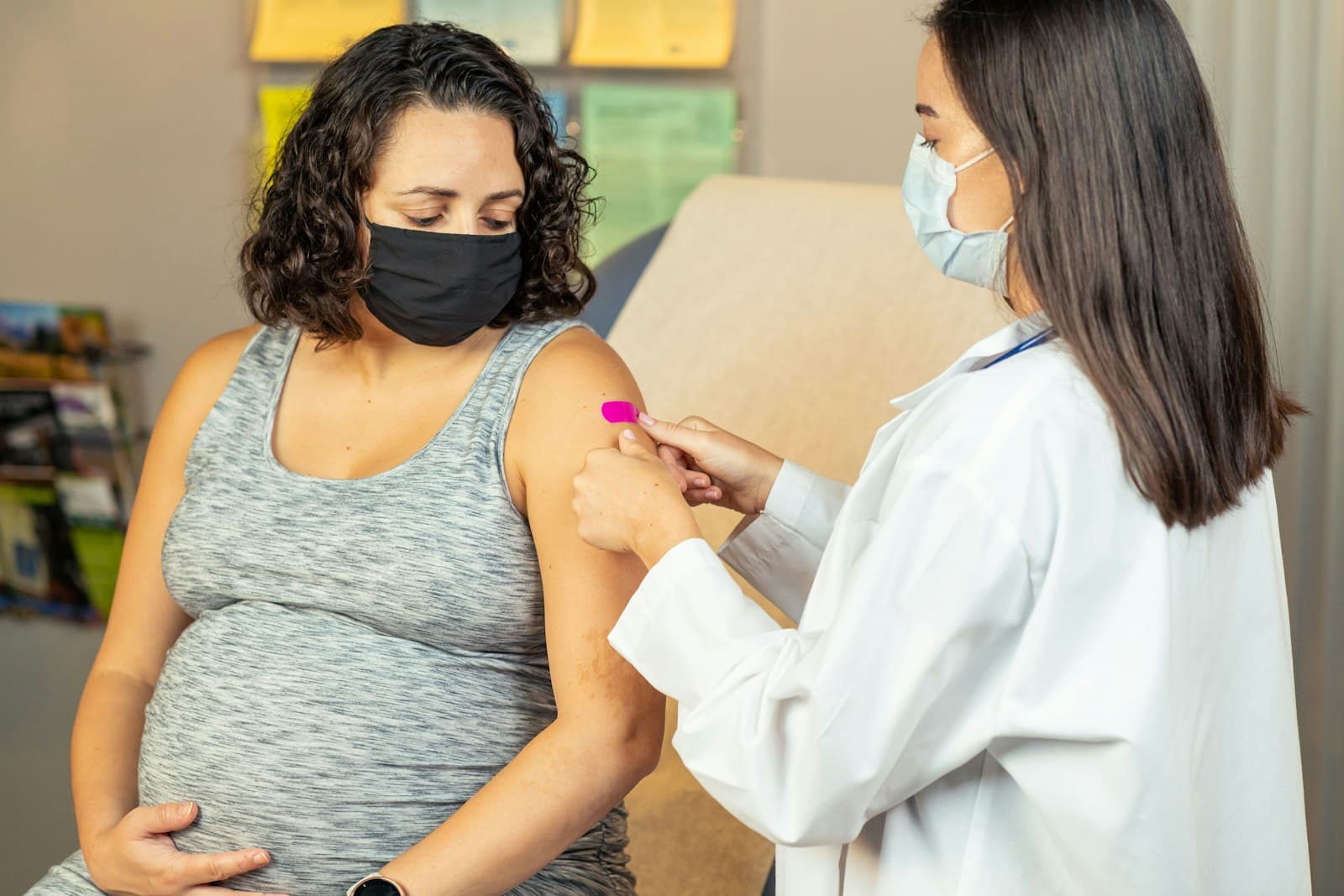
Yes. The CDC says the flu vaccine is safe for breastfeeding women and their babies from 6 months, and vaccinated mothers make antibodies that pass to the baby through breast milk. Babies under 6 months cannot be vaccinated, so the CDC also recommends vaccinating household members and carers of the youngest babies.
In Poland the flu vaccine is given at POZ clinics and, for adults, also at pharmacies with a vaccination point. According to PZH (the Polish National Institute of Public Health), in the 2026/2027 season the flu vaccine is free for women in the postpartum period, on a prescription marked with code C. After that the rules for other adults apply and change every season, so check the current terms on pacjent.gov.pl (the official patient portal) or ask a doctor or pharmacist.
When should a breastfeeding mother see a doctor?
The NHS says flu often gets better on its own, and antibiotics do not work for viral infections. Even so, the NHS recommends an urgent GP appointment if you have flu symptoms and have recently given birth, feel very unwell, are short of breath or your symptoms have not improved after 7 days. The CDC recommends antiviral treatment for women shortly after birth (for example within 2 weeks) with suspected or confirmed flu, and oseltamivir is the preferred medicine for breastfeeding mothers.
- See a doctor urgently: flu symptoms soon after giving birth, feeling very unwell, shortness of breath, or no improvement after 7 days.
- See a doctor the same day: fever with chills and a painful, hot, red area on your breast. This may be mastitis rather than flu. We cover the symptoms and treatment in our article on mastitis and blocked ducts.
- Call 112 or go to the emergency department: sudden chest pain, severe difficulty breathing (you are gasping or cannot get words out), coughing up blood. These are the warning signs listed by the NHS.
How can a midwife or lactation consultant help?
If after an illness your baby asks for the breast more often or your breasts feel less full, it is worth asking for help. A midwife or lactation consultant can watch a feed, check your baby's weight gain and wet nappies, and if your supply has dropped, put together a plan of more frequent feeding and expressing. She can also go through the medicines you are taking and suggest what to ask your doctor.
After birth you are entitled to free home visits (wizyty patronażowe) from your POZ midwife, and you can ask about feeding during them too. If you are ill and would rather not leave home, on MyMidwife you will find midwives with lactation experience who will come to your home or talk to you online.