When can I take my newborn out for a walk?
Medycyna Praktyczna writes that there is basically nothing to stop you going for a walk in your baby's first week of life, as long as the weather allows, meaning the warm time of year, and so does the newborn's health. The UK's NHS says much the same in its leaflet for parents taking babies home from a neonatal unit: there is no reason not to take your baby out if they are dressed for the weather.
In autumn and winter, what matters is less the baby's age in days than the weather and how your baby copes with the cold. Medycyna Praktyczna does not give a separate starting date for the cold season, but says the first walks on cold days should be short, usually 10-15 minutes, and can then be lengthened gradually. Before the first walk in the cold, you can spend 1-2 days getting your baby used to it at home: dress them as for a walk and open the window wide for 10 to 20 minutes, several times a day. In Poland this is often called werandowanie (from weranda, a veranda).
The popular Polish advice to wait 2 weeks or more before the first walk is not backed by any of the guidance we found. It is a custom, not a medical rule. Premature and unwell babies are a different matter, covered below.
The NHS also advises avoiding rush hours, crowded places and contact with anyone who is ill in the first weeks if you can, because some babies pick up infections more easily. A walk in the park is not the same as a trip to a shopping centre.
At what temperature can I go out with a newborn, and when should I stay home?
There is no fixed limit. Medycyna Praktyczna points out that in Poland temperatures below zero can last as long as 3-4 months a year, so walks in the cold are normal. It gives -10°C as the lower limit, with the caveat that this is what is generally accepted rather than something based on research. Wind, damp and whether the sun is out matter too.
| Conditions | What the sources say |
|---|---|
| Above zero | According to Medycyna Praktyczna you can go out even several times a day, fitting the length of the walk to the weather and your daily routine. |
| Frost down to about -10°C | Medycyna Praktyczna suggests going out once or twice a day, ideally in the middle of the day when it is warmest, and starting with short walks. |
| Below about -10°C | This is the limit Medycyna Praktyczna describes as generally accepted. In this kind of frost it is better to stay home or keep to a short trip out. |
| Strong wind | Wind chills faster than the temperature alone. Medycyna Praktyczna notes that a deep pram gives good protection from wind. |
| Rain, wet clothes | Wet clothes chill a baby quickly. The pram hood and rain cover protect against rain, and wet clothes should be changed as soon as you get home. |
| Smog: index bad or very bad | GIOŚ, the Polish Chief Inspectorate of Environmental Protection, advises small children to avoid being outdoors. |
How should I dress my newborn for a walk in autumn and winter?
The simplest rule, given by both the NHS and the American Academy of Pediatrics (AAP), is to dress your baby in one more layer than you are wearing. The NHS adds that if you feel chilly, your baby probably does too. Several thin layers keep a baby warmer than one thick layer because air is trapped between them, and it is easy to take one off when you go somewhere warm.
| Layer | What to put on |
|---|---|
| Next to the skin | A close-fitting long-sleeved bodysuit, ideally cotton. |
| Middle | A sleepsuit, plus a cardigan or thin fleece on cold days. |
| Outer | A warm, roomy pram sleeping bag with a hood, or a snowsuit. Medycyna Praktyczna recommends them especially for frosty days. |
| Head | A hat that covers the ears. Medycyna Praktyczna notes that ears get cold very quickly. |
| Hands and feet | Mittens with a single finger section that will not slip off, and socks or warm bootees. |
In below-zero temperatures, Medycyna Praktyczna suggests putting a thin layer of protective cream on your baby's face. The bottom of the pram should be fully covered with an insulating mattress, because heat is also lost through the base of the carrycot.
As soon as you get home, and also in a warm shop, bus or car, take off your baby's hat and outer layer straight away. The NHS stresses doing this even if it wakes your baby. According to the Lullaby Trust, a UK charity focused on safer infant sleep, the head is one of the main ways a baby loses excess heat.
How can I tell if my baby is too cold or too hot?
Feel the back of your baby's neck, their back or their chest. The Lullaby Trust and the NHS agree that a baby's hands and feet are often cool and tell you little about whether they are warm enough. The neck should feel warm and dry. If it is sweaty or clammy, your baby is too hot and you should take off a layer.
Signs your baby may be too cold, according to the NHS:
- they are unusually quiet,
- they look pale or slightly blue,
- they feel cool to the touch on the neck, back or chest,
- they refuse feeds.
Signs your baby is overheating, according to the NHS and the AAP:
- they are irritable and grizzly,
- they are sweaty, especially on the neck,
- they feel hot to the touch or have flushed skin,
- they are breathing faster than usual.
Overheating is more dangerous than it seems. The Lullaby Trust, the NHS and the AAP say it increases the risk of sudden infant death syndrome (SIDS), and the NHS adds that babies are better off slightly cool than too hot. Medycyna Praktyczna describes a well-dressed baby as one who sleeps calmly, does not cry and comes back from a walk with warm hands and feet.
Pram, sling or carrier: which is better in winter?
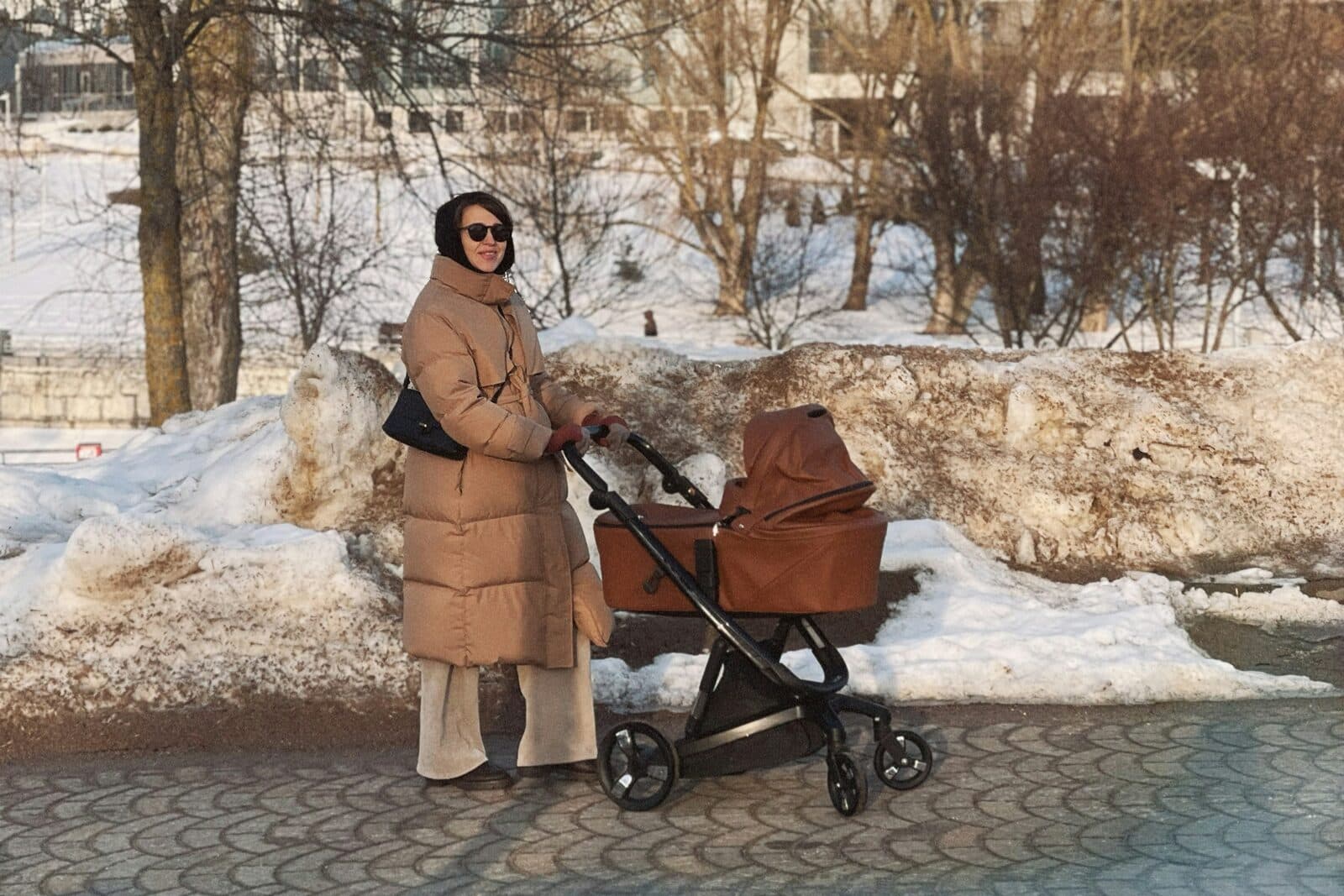
For autumn and winter walks with a newborn, Medycyna Praktyczna recommends a deep pram with a carrycot (called a gondola in Poland), where the baby lies on their back. This kind of pram protects well from wind, especially from late autumn to early spring. The NHS also stresses that a young baby in a pram should be able to lie flat on their back.
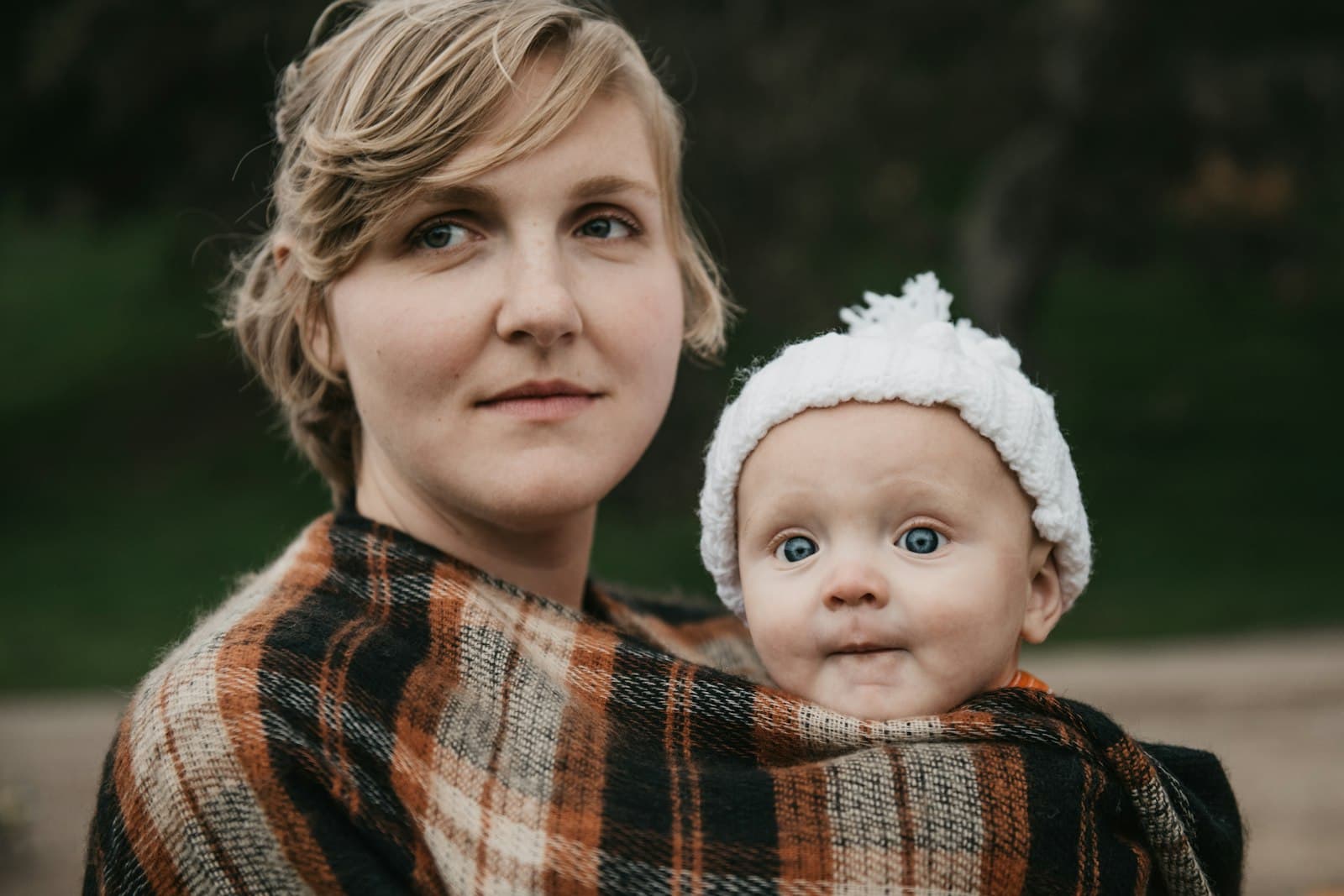
According to Medycyna Praktyczna, a sling is useful for short trips or where a pram is hard to manage. It must be snug, with the baby securely supported. In a sling your baby is also warmed by your body, so they overheat more easily, especially under your coat. Check the back of their neck and make sure their face is always uncovered and visible.
Do not cover the pram with a blanket, a cloth nappy or a muslin. The Lullaby Trust warns against any cover that stops air flowing: it risks overheating and makes it harder to notice if your baby is in trouble. The pram hood protects against wind and rain, and if you use a rain cover, take it off once the rain stops.
Can my newborn travel in a car seat wearing a snowsuit?
No. The AAP explains that bulky clothing, including winter coats and snowsuits, should not be worn under the harness of a car seat. In a crash the padding compresses, the straps become loose and the child can slip out of them. The NHS leaflet for parents adds that an overdressed baby easily overheats in a warm car.
- Dress your baby in thin, close-fitting layers, for example a long-sleeved bodysuit, a sleepsuit and a thin fleece.
- Buckle the harness and do the pinch test: if you can pinch a fold of the strap at your baby's shoulder, tighten the straps.
- Only then put a blanket over the buckled harness, or put a coat on backwards over the straps.
- Once the car warms up, take off the outer layer and the hat.
- The AAP suggests keeping the infant carrier car seat indoors at room temperature so your baby does not lose heat in a cold seat.
- Do not use inserts or car seat sleeping bags that did not come with the seat, because they have not been crash tested with it.
A car seat is for travelling, not for sleeping. The AAP advises that if your baby falls asleep in a car seat, pushchair seat or sling, you should move them onto a firm, flat surface on their back as soon as possible.
Can my newborn sleep on the balcony or in a pram outdoors?
In the Nordic countries, Finland for example, daytime naps in a pram outdoors, even in frost, are a common custom. A study at the University of Oulu in Finland showed what this looks like in practice:
- Three-month-old babies slept outdoors on average 92 minutes longer than indoors.
- At the same time, their skin cooled faster the lower the temperature, despite warmer clothing. When it cooled faster, naps were shorter. The authors write that clothing only partly made up for the extra heat loss.
- The study describes a custom in Finnish families, not a medical recommendation.
None of the sources we checked gives official rules for a newborn sleeping outdoors. If you want to try it on a balcony, start with short periods, keep your baby within sight and hearing, do not cover the carrycot and check the back of their neck regularly. Think about air quality too: on a balcony above a busy road or on a smoggy day, your baby breathes the same air as on a walk.
Smog and walks with a baby: how do I check air quality?
In Poland, the heating season is also smog season. GIOŚ, the Chief Inspectorate of Environmental Protection, publishes current measurements on the powietrze.gios.gov.pl portal and in its free app Jakość powietrza w Polsce (Air quality in Poland). The app shows hourly measurements, and GIOŚ also provides forecast maps of air pollution for today and the next two days. The Polish air quality index has 6 levels: very good, good, moderate, sufficient, bad and very bad. GIOŚ lists small children among the especially sensitive groups:
- Very good and good: according to GIOŚ you can be outdoors without restrictions.
- Moderate: pollution may be a health risk in particular cases, including for small children.
- Sufficient: pollution is a health risk, especially for small children, and GIOŚ advises considering shortening or spreading out time spent outdoors.
- Bad: GIOŚ says small children should avoid being outdoors.
- Very bad: small children should strictly avoid being outdoors.
Check the index for the station nearest your home just before you go out, not only in the morning, because air quality changes during the day. In its advice for parents, Medycyna Praktyczna suggests keeping children at home on days with high pollution, and on walks choosing routes away from busy streets and staying as far from the kerb as possible. Windows facing a busy street are best kept closed at rush hour. In its guide to walks, Medycyna Praktyczna recommends parks, woods and meadows far from major roads and industrial sites.
Premature or unwell babies and the midwife's role: what should I ask?
In its leaflet for parents taking babies home from a neonatal unit, the NHS explains that premature and low birth weight babies have very little fat and get cold quickly. According to the NHS, babies weighing less than 2.5 kg may need slightly warmer clothing even at home. In that case, agree the timing and length of the first walks with your baby's neonatologist, paediatrician or midwife.
If your baby has a cold, a fever or seems unwell, ask your midwife or doctor before going for a walk.
The patronage visit (wizyta patronażowa, the free home visits by your NFZ-funded community midwife after birth) is a good time to ask about all of this. Under the Polish perinatal care standard, the community midwife (położna POZ) assesses and records, among other things, your baby's body temperature, how they are dressed and the hygiene and safety of the room they stay in, and gives advice on caring for your baby. You can ask her to watch how you dress your baby for the pram, how you settle them in the carrycot and how you buckle them into the car seat. If you need more time or a visit at another time, a private midwife can come to your home.
If after a walk and warming up at home your baby still feels cool on the neck and chest, looks pale or blue, is drowsy or will not feed, do not wait for the next visit: contact a doctor urgently. In an emergency, call 112.