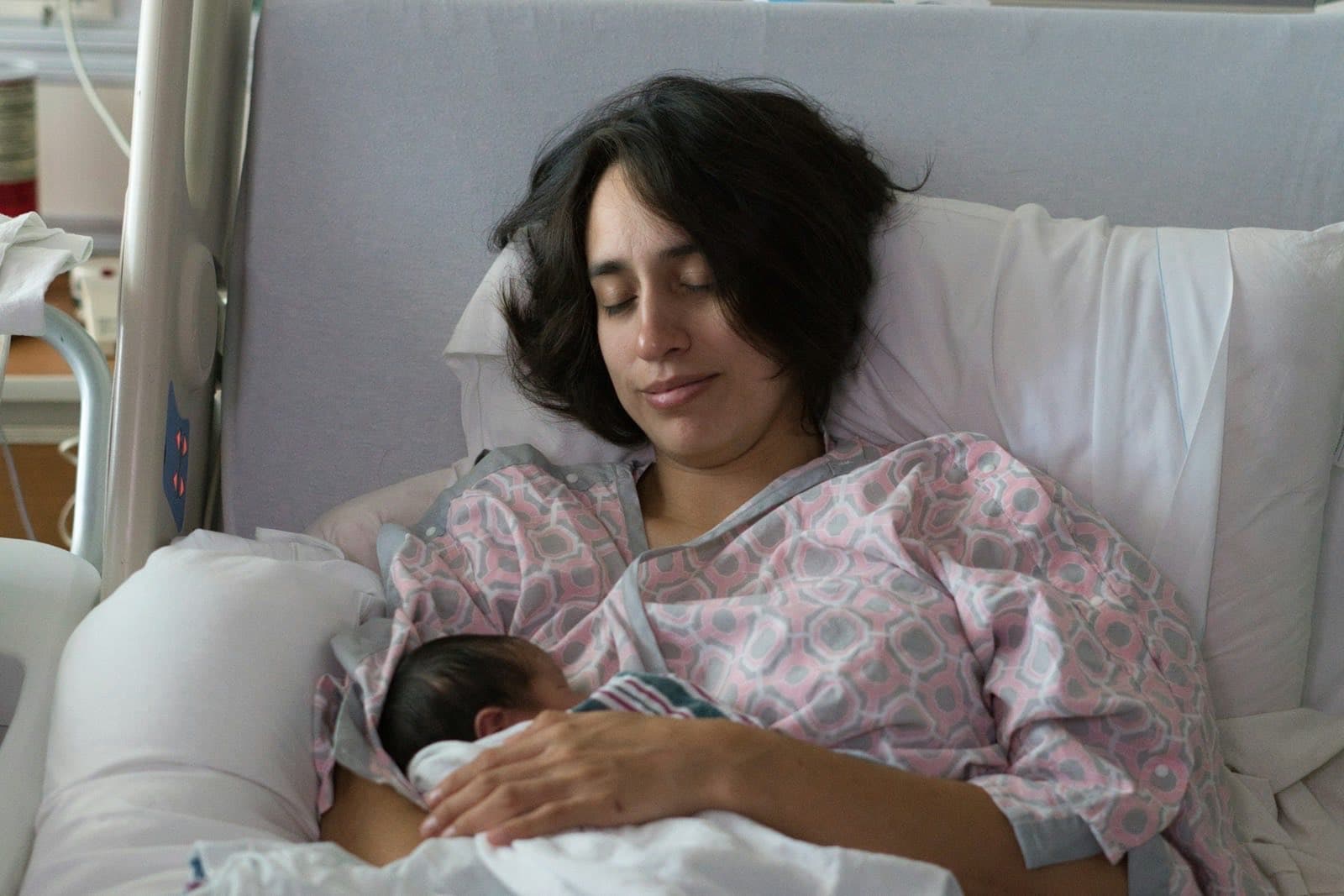
How long does healing after a caesarean take?
The UK Royal College of Obstetricians and Gynaecologists (RCOG) says the recovery period after a caesarean birth is usually about 6 weeks, but it can vary. The postpartum period (połóg) lasts just as long, so during this time it is not only the wound on your abdomen that heals: the uterus also contracts and you have postpartum bleeding (lochia). The table shows a typical course, not a rigid schedule.
| When | What usually happens | What to watch for |
|---|---|---|
| First 24 hours | You get out of bed as soon as you can. A urinary catheter stays in for at least 12 hours. You can eat and drink when you feel hungry or thirsty. The dressing usually comes off after 6-24 hours, later in some hospitals. | Wound pain is at its strongest, so you are given pain relief regularly. Ask for help getting up and bringing your baby to the breast. |
| First days and discharge | The hospital stay is usually longer than after a vaginal birth. The hospital decides when you go home based on your condition and your baby's. | Before discharge, ask what kind of stitches you have, whether and when they need removing, how to wash the wound and which medicines to take at home. |
| 5-7 days | Non-dissolvable stitches or staples are usually removed after 5-7 days. At home your POZ midwife can do this during a home visit (wizyta patronażowa). | Slight redness along the wound, a little swelling and a small amount of clear, straw-coloured fluid can be part of normal healing. |
| 1-2 weeks | Wound pain eases noticeably. According to mp.pl, pain linked to the healing abdominal wall can last up to about 2 weeks. | Pain, redness and swelling should get less day by day. If they increase, call your midwife or doctor. |
| Around 6 weeks | The postpartum period ends. Most women return to driving, lifting and exercise around this time, though it may take longer. | A check-up with the obstetrician after the postpartum period. The doctor may look at the scar and talk to you about contraception. |
| The following months | The scar is red and obvious at first and then gradually fades. According to the RCOG, 1 in 10 women have discomfort for the first few months. | Numbness or tingling around the scar is common. Tell a doctor about pain that does not go away or keeps coming back. |
What happens in hospital after a caesarean?
After the operation you are given pain relief, and from the start you can have close contact with your baby, including skin-to-skin, and begin breastfeeding. Staff encourage you to get out of bed and start walking as soon as possible. Moving helps healing and lowers the risk of blood clots, which is why in hospital you may also be given compression stockings or anti-clotting injections.
- Catheter: according to the NICE guideline it is removed once you are walking, but no sooner than 12 hours after the last dose of the spinal or epidural anaesthetic.
- Eating and drinking: if you feel well and there are no complications, you can eat and drink as normal.
- Dressing: NICE recommends removing a standard dressing 6-24 hours after the operation, and some hospitals leave it on for 48 hours. A special negative pressure dressing stays on longer.
- First shower: with the dressing on you can usually shower, but not take a bath. The university hospital in Poznań advises showering only, in warm water, without pointing the stream directly at the wound.
The hospital stay is usually longer than after a vaginal birth. The UK NICE guideline allows discharge after as little as 24 hours if you are recovering well and have no fever or complications, but the doctor at your hospital decides when you go home. If the caesarean was an emergency or unplanned, you have the right to talk to the staff about why it happened and what a future birth could look like.
How do I care for a caesarean wound at home?
A caesarean wound is usually 10-20 cm long and runs horizontally just above the pubic hairline, less often vertically below the belly button. What matters most is keeping it clean and dry. Once the dressing is off, new skin already covers the wound, so another dressing is usually not needed, although healing continues beneath the surface.
- Wash the wound every day in the shower, gently, with your hand rather than a sponge or flannel.
- Pat it dry with a clean towel that nobody else uses, or with a paper towel.
- Wear loose clothes and high-waisted cotton underwear so the waistband does not rub the wound.
- Wash your hands before touching the skin around the wound, after using the toilet and after changing nappies.
- Look at the wound every day, lifting any skin fold and using a mirror if needed.
- Do not smoke: even one cigarette reduces blood flow to the skin and raises the risk of wound infection.
Hospitals differ in the details of their advice, for example whether and for how long to use an antiseptic. Follow the instructions you were given at discharge, and if in doubt ask your POZ midwife. If you have non-dissolvable stitches or staples, they are usually removed after 5-7 days. Your POZ midwife can do this at home if needed.
Numbness, tingling or altered sensation in the skin around the scar is common, because small nerves responsible for surface sensation are cut during the operation. According to mp.pl this can last from a few weeks to a few years and is not in itself a sign of a complication.
How do I manage pain after a caesarean while breastfeeding?
Most women have discomfort for the first few days, and for some the pain lasts several weeks. Wound pain gets worse when you get up, sit down, cough or sneeze. While breastfeeding you may also feel cramps in your lower abdomen, because the oxytocin released then makes the uterus contract. This is a good sign that the uterus is returning to normal.
The NICE guideline says women who want to breastfeed will usually be able to do so and care for their baby while taking pain relief. According to the NHS, paracetamol or ibuprofen are usually better than aspirin while breastfeeding, and aspirin and codeine are not usually recommended. Pain relief works best taken regularly rather than only when the pain is bad, because it makes moving easier. Agree doses and the choice of medicine with your doctor or pharmacist.
If you leave hospital with a stronger opioid painkiller, contact your doctor if your baby is unusually drowsy, has breathing difficulties, constipation or is feeding poorly. According to NICE, a caesarean on its own does not increase the risk of breastfeeding difficulties, and the Polish perinatal care standard requires hospitals to take particular care to allow frequent feeding after a caesarean. Your midwife will help you find a position in which your baby does not press on the wound.
When can I lift, drive, exercise and have sex again?
The NICE guideline gives no fixed dates: you can return to driving, carrying heavy things, exercise and sex when you feel you have fully recovered and movement is not painful. The NHS adds that this usually takes about 6 weeks. If you are not sure, ask your midwife or the doctor at the check-up after the postpartum period.
- Walking: start by moving around the house, then take a short walk of a few minutes outside and gradually go further. Daily movement lowers the risk of blood clots, but do not overdo it.
- Lifting: you can hold and carry your baby from the start. For a few weeks avoid lifting anything heavier than your baby and ask family or friends to help at home.
- Driving: the RCOG advises not planning to drive for about 6 weeks. Go back to it when nothing restricts you and you feel no pain.
- Exercise: put intense sport off for a few weeks. Your POZ midwife will show you postnatal and pelvic floor exercises, and you should tell her or a doctor about any leaking urine.
- Sex: return to it when nothing hurts and you feel ready. Some hospitals advise in their discharge instructions waiting until the doctor's check-up after the postpartum period.
Remember contraception: according to the NHS you can get pregnant as early as 3 weeks after giving birth, even while breastfeeding and before your first period. It is best to agree on a method with a doctor or midwife while still in the postpartum period.
Is there postpartum bleeding and are there midwife visits after a caesarean?
Yes. After a caesarean the uterus also cleans itself, so bleeding from the vagina is normal. Use pads rather than tampons, so as not to carry infection into the vagina, and change them often. How the bleeding changes over the following weeks is described in our article on how long the postpartum period lasts.
After discharge you are entitled to 4 to 6 free home visits (wizyty patronażowe) from your POZ midwife (the primary care midwife funded by the public health fund, NFZ). The perinatal care standard provides for no fewer than four visits, with the first within 48 hours (excluding weekends and public holidays) of the birth being reported or of your discharge from hospital. The midwife checks, among other things, the caesarean wound, how your uterus is contracting, your bleeding, breasts and milk supply, passing urine and stools and how you are feeling, and removes stitches from the abdomen if needed.
If you need more time with a midwife, for example when breastfeeding gets off to a difficult start, you can also book a private postnatal home visit. After the postpartum period, go for a check-up with an obstetrician, who may look at the scar.
Which symptoms after a caesarean need urgent help?
According to the RCOG, infection of the wound or uterus affects 2-7 in 100 women after a caesarean and can take several weeks to heal, so it is worth knowing which symptoms need to be checked. Most signs of infection are exaggerated versions of normal healing: the key question is whether things are getting better or worse day by day. If you are not sure which group your symptom belongs to, choose the more urgent one.
| What to do | Symptoms |
|---|---|
| Call 112 | Sudden breathlessness or chest pain, because a clot may have reached the lungs. Very heavy bleeding with dizziness or weakness. |
| Go straight to the emergency department (SOR) or the admissions unit of a hospital with a maternity ward | Pain and swelling in one calf. Heavy vaginal bleeding. Fever with abdominal pain and abnormal vaginal discharge. A severe headache that does not go away with ordinary painkillers, or vision problems such as spots or flashing lights. |
| Call your midwife or doctor the same day | A wound that is increasingly red, swollen and painful, including at rest. Pus, bleeding or an unpleasant smell from the wound. The edges of the wound coming apart. Fever or feeling generally unwell. A cough or breathlessness. Pain when passing urine or leaking urine. |
| Ask at your next midwife visit | Slight redness along the wound, a little swelling, a small amount of clear fluid, numbness around the scar, pain that eases day by day. |
In the evening, at night and at weekends, do not wait for your midwife. Night and holiday healthcare (nocna i świąteczna opieka zdrowotna) runs from Monday to Friday from 18:00 to 8:00 and around the clock on public holidays, and you can go to an emergency department or admissions unit without a referral. Do not drive yourself to hospital: ask someone close to you or call for help. We cover postpartum warning signs in more detail in our article on when to call the midwife and when to go to hospital.
When can I get pregnant again after a caesarean?
The WHO recommends waiting at least 24 months after a live birth before trying for the next pregnancy, because shorter intervals are linked to higher risks for mother and baby. This applies to all births, not only caesareans. The WHO report also describes that among women with a previous caesarean who laboured in the next pregnancy, a very short interval of under 16 months was linked to a higher risk of uterine rupture.
Most women who have had a caesarean have no problems in later pregnancies, and many can give birth vaginally next time. Discuss the plan for your next birth with the doctor looking after your pregnancy, who will assess the scar and your obstetric history.